| Source | Candidate | Sharpe (t) | Alpha on standard, % p.a. (t) | Passive |α|, % p.a. | Sh²(α), test portfolios | OOS Sharpe |
|---|---|---|---|---|---|---|
| CoinGecko | CSTR Short-term reversal (1 week) | -1.19 (-3.4) | -7.3 (-0.6) | 4.3 → 4.3 | 6.31 → 6.31 | 1.04 → 0.83 |
| CoinGecko | CLTR Long-term reversal (50 weeks) | -0.50 (-1.4) | -0.6 (-0.0) | 4.3 → 4.3 | 7.00 → 7.14 | 1.04 → 0.92 |
| CoinGecko | CMAX Lottery (max daily return, low minus high) | 0.46 (1.3) | 26.5 (1.9) | 4.3 → 4.6 | 7.14 → 6.82 | 1.04 → 1.13 |
| CoinGecko | CVOL Low volatility (30-day) | 1.15 (3.2) | 23.6 (1.6) | 4.3 → 4.7 | 6.64 → 6.33 | 1.04 → 1.09 |
| CoinGecko | CBETA Betting against beta (365-day) | 0.50 (1.4) | 7.0 (0.5) | 4.3 → 4.5 | 7.12 → 7.08 | 1.04 → 0.98 |
| CoinGecko | CILLIQ Illiquidity (Amihud, 30-day) | -0.92 (-2.6) | 6.2 (1.1) | 4.3 → 4.3 | 4.17 → 4.03 | 1.04 → 1.00 |
| CoinGecko | CLIQ Illiquidity (EDGE bid-ask spread, 30-day) | -1.04 (-2.9) | -11.9 (-0.8) | 3.3 → 3.6 | 6.32 → 6.35 | 1.40 → 1.44 |
| CoinMarketCap | CSTR Short-term reversal (1 week) | -1.15 (-3.3) | -4.6 (-0.4) | 3.4 → 3.4 | 7.33 → 7.30 | 1.17 → 1.02 |
| CoinMarketCap | CLTR Long-term reversal (50 weeks) | -0.42 (-1.2) | 8.3 (0.5) | 3.4 → 3.3 | 7.37 → 7.38 | 1.17 → 1.12 |
| CoinMarketCap | CMAX Lottery (max daily return, low minus high) | 0.52 (1.5) | 26.0 (1.8) | 3.4 → 3.6 | 7.37 → 7.30 | 1.17 → 1.14 |
| CoinMarketCap | CVOL Low volatility (30-day) | 1.24 (3.5) | 28.8 (1.9) | 3.4 → 4.0 | 7.15 → 6.65 | 1.17 → 1.13 |
| CoinMarketCap | CBETA Betting against beta (365-day) | 0.60 (1.7) | 8.4 (0.6) | 3.4 → 3.7 | 7.23 → 7.30 | 1.17 → 1.17 |
| CoinMarketCap | CILLIQ Illiquidity (Amihud, 30-day) | -1.67 (-4.7) | -25.2 (-3.1) | 3.4 → 3.2 | 6.56 → 5.34 | 1.17 → 1.32 |
Candidate Factors
Do reversal, volatility or liquidity add anything to the standard?
Work in progress. These are first results for factors that might join the standard. Nothing here is a recommendation yet; the series are not part of the published data.
How candidates are built and judged
Each candidate is a long-short portfolio on one characteristic. It is built exactly like the standard’s size and momentum factors: coins with a previous-week average market cap of at least $1M, value weights, terciles, breakpoints from coins worth at least $100M, and at least five coins per leg, on ISO weeks. A candidate earns a place in the model only if it passes four tests, from 2018 onward:
- Is it new? Its alpha against the standard three factors must be clearly positive (Barillas & Shanken, 2017).
- Does it keep the benchmark fair? Passive investable portfolios must not get larger alphas once it is added.
- Does it price better? The mispricing of the investable characteristic portfolios must fall. Test portfolios that correlate more than 0.7 with the candidate are left out, so that the candidate cannot win simply by pricing itself.
- Does it help out of sample? The out-of-sample tangency Sharpe ratio of the standard plus the candidate must rise.
Results
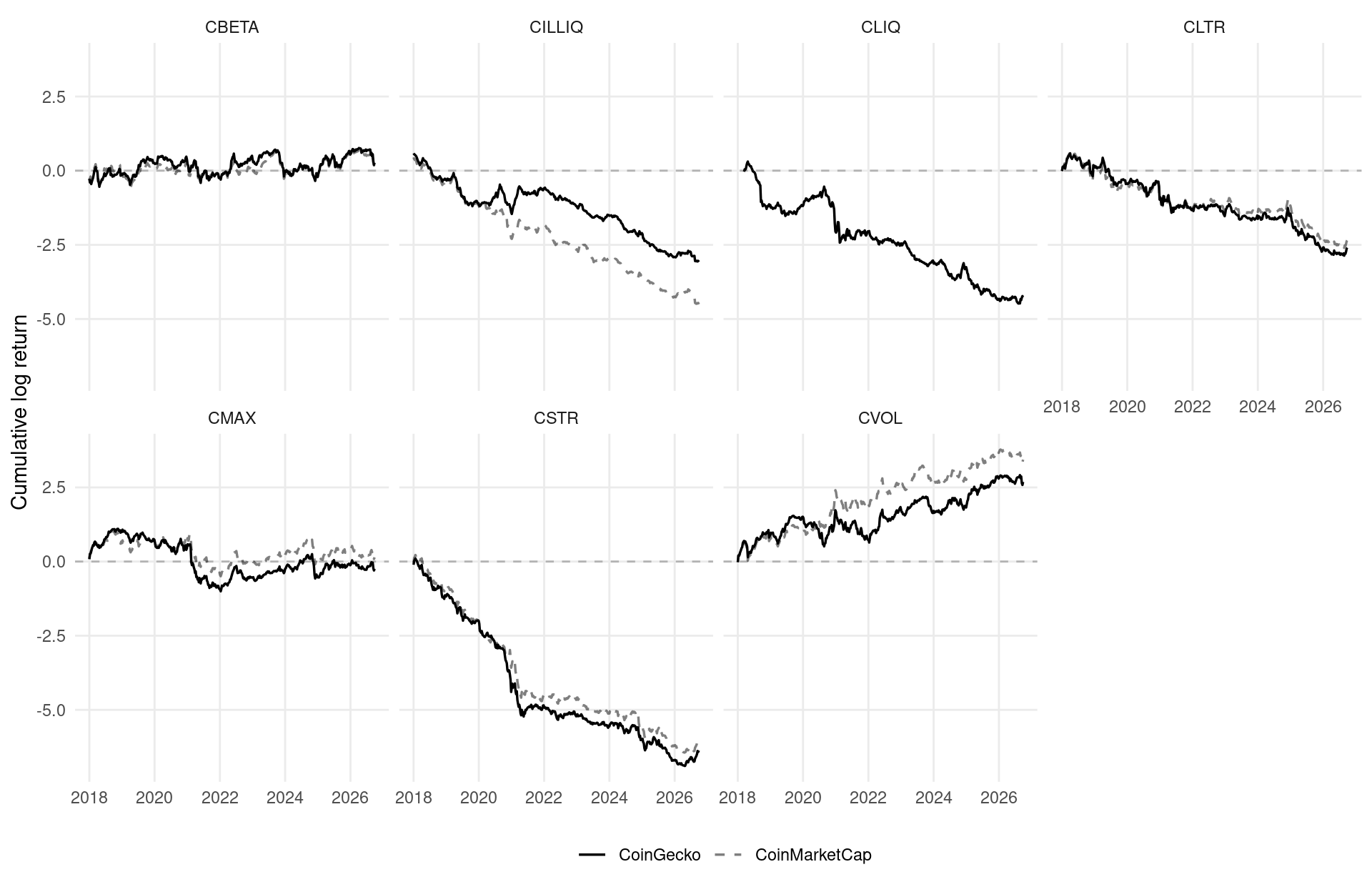
What we see so far
- Short-term reversal does not exist among investable coins. Last week’s losers keep losing (a negative Sharpe ratio for losers minus winners). This is one-week momentum, and our momentum factor already contains it: no alpha on the standard.
- Long-term reversal and betting against beta add nothing.
- Low volatility is the strongest price-based candidate. Low-volatility coins earn more than high-volatility coins, with an alpha on the standard of about 25% a year (–), and it improves pricing. Its cost: passive portfolios get slightly larger alphas, and Bitcoin’s turns negative.
- Liquidity has a negative premium. Illiquid investable coins earn less than liquid ones, by both the Amihud measure and the EDGE spread. The EDGE spread is largely explained by the standard factors, mostly size. The Amihud factor carries additional information on CoinMarketCap () but not on CoinGecko.
Liquidity from open, high, low and close prices
Crypto aggregators report no bid–ask quotes, but they do report daily open, high, low and close prices. The EDGE estimator of Ardia et al. (2024) recovers the effective bid–ask spread from these four prices. It is unbiased, and much more efficient than earlier range-based estimators such as Corwin and Schultz. We estimate it over the last 30 days for every coin with the authors’ R package bidask.
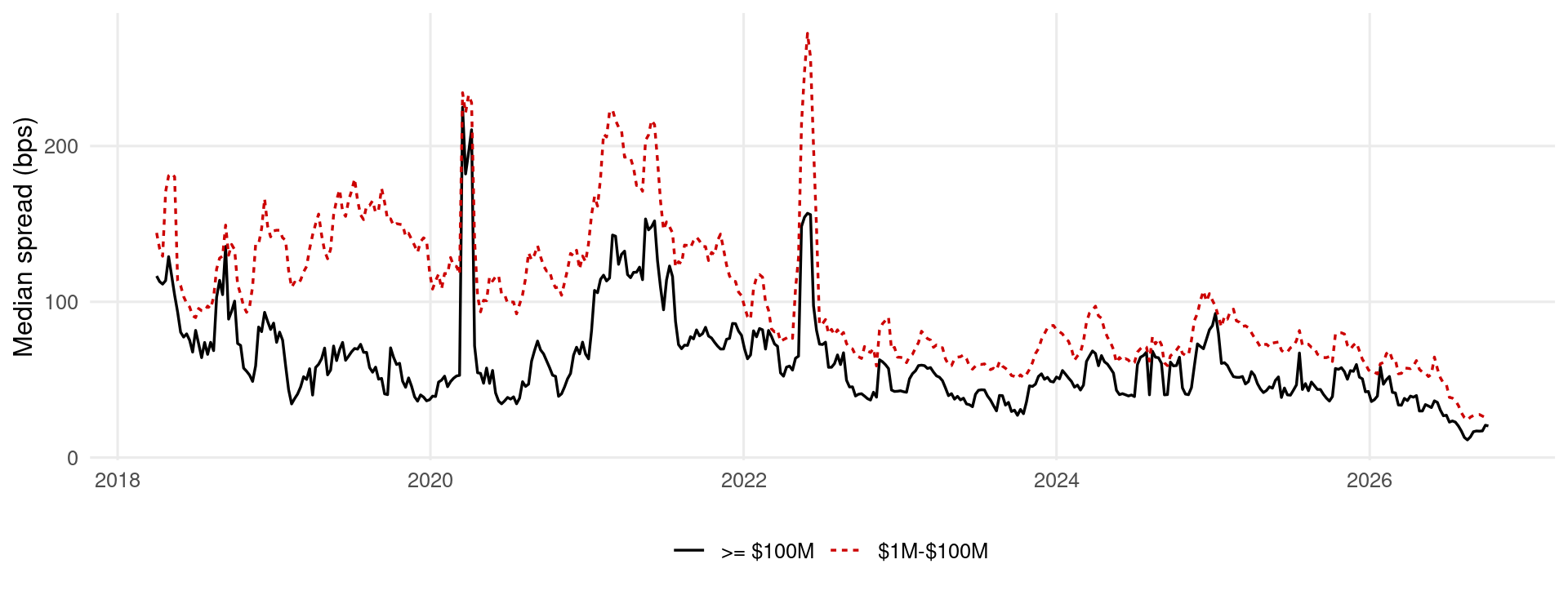
Spreads have fallen steadily. Investable coins trade more cheaply than small coins, recently at around 30–35 basis points against about 55.
Data status. EDGE needs a real daily price range. CoinGecko’s daily OHLC before February 2018 is synthetic: open, high, low and close all equal the previous day’s price. Between 1% and 20% of later coin-days per year also have no range (high = low). We therefore estimate EDGE from February 2018 onward, and only from days with a real range. The CoinGecko OHLC currently runs to the end of September 2026. Daily OHLC from CoinMarketCap is being restored, so the CoinMarketCap EDGE series and a continuously updated liquidity factor will follow.
Next steps
- the same multiverse and non-standard errors for the candidates as for the standard;
- bootstrap confidence for every improvement, as for the standard;
- the EDGE factor on CoinMarketCap and with continuous updates;
- a decision on whether a four-factor standard (e.g. with low volatility or liquidity) is fairer and prices better than the three-factor standard.
References
Ardia, D., Guidotti, E., & Kroencke, T. A. (2024). Efficient estimation of bid–ask spreads from open, high, low, and close prices. Journal of Financial Economics, 161, 103916.
Barillas, F., & Shanken, J. (2017). Which alpha? The Review of Financial Studies, 30(4), 1316–1338.